“The best three months” is a concept developed by Tarron Estes and the Institute of Conscious Dying. The chart template below suggests processes for affirming and determining the quality of the pathway to transformation by stating spiritual/emotional preferences, as well as those for the dispensation of the body. For example, the first of five categories is “spirit”. How would the dying person like to have his/her/their spiritual values represented leading up to and during their passing? They may want clergy to be present or may not. Perhaps there are works of poetry or Bible verses that he/she would like to have read.
The spirit/emotion/mind/body/practical categories are rich in overlap and encourage decisions that determine the aesthetic of the dying scene–colors, smells, personnel, music, photos, artworks, and special mementos are all included in the possibilities. During a time when it seems there is little to do but wait for the end, the patient may be invigorated by the opportunity to make decisions and determine some aspects of their final times.
Newer thinking on end of life and aftercare hinge on three principles: conscious death, home funeral, and green burial. These are somewhat controversial practices that were actually once normal and common. While there may be a desire on the part of some to return to these more natural principles, the preferences of the patient and their family must always unquestionably be honored in every instance.

Click on the picture to view it better or click on the “Download” button for the pdf version of the above chart to see it in more detail.
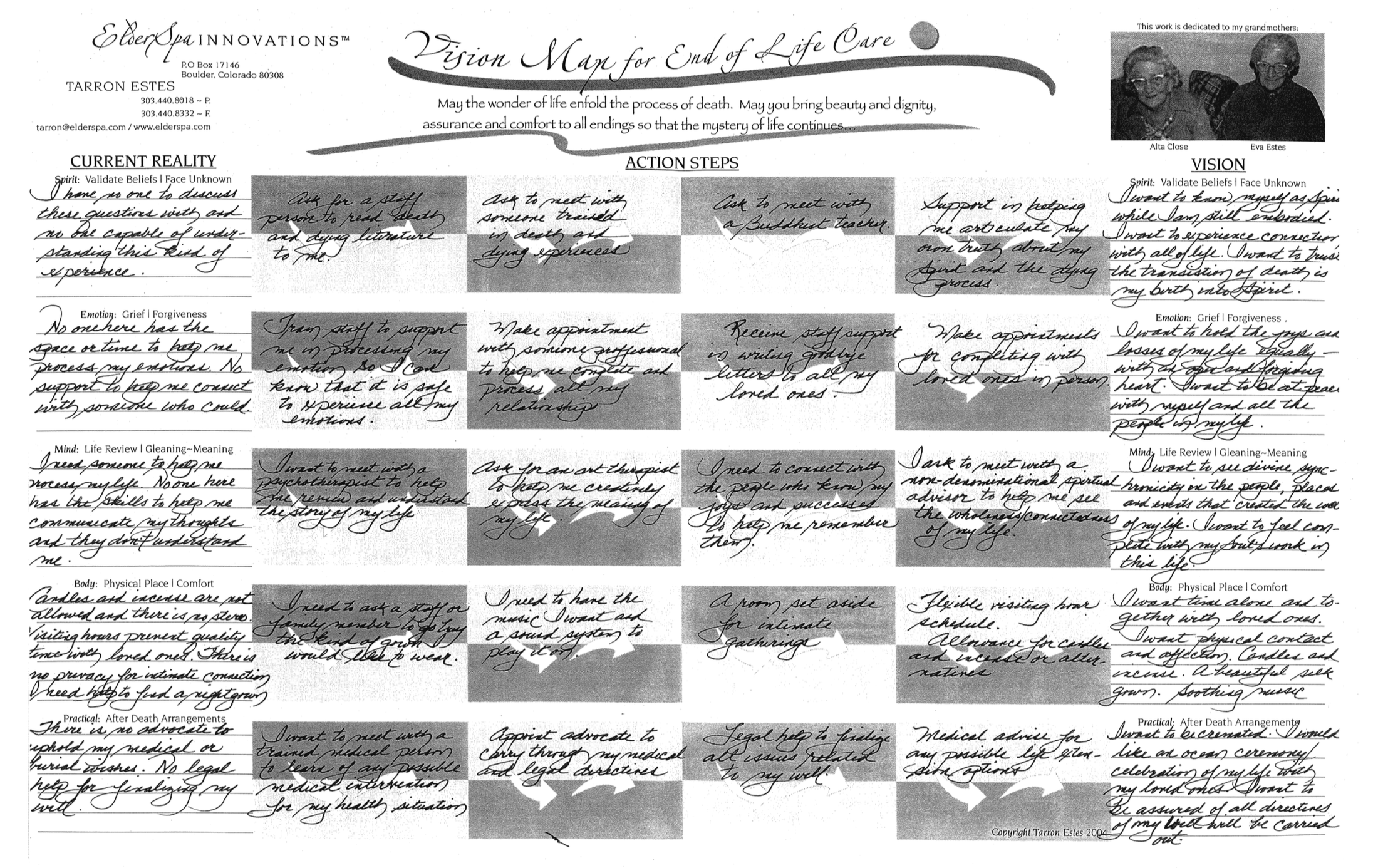
Click on the picture to view it better or click on the “Download” button for the pdf version of the above chart to see it in more detail.
The “Best Three Months” is a process that starts with the end in mind. Above and below are two BTM charts fully filled out. The patient is encouraged to imagine or envision the goal FIRST. These may be abstract goals such as “I want to feel complete with my soul’s work in this life,” suggesting a desire for inner work, perhaps with a friend or guide. Or the goal may be very concrete, such as “I want to be cremated and have my ashes scattered on the ocean.” Within the spaces that precede each goal or vision, the patient writes the steps that are needed to achieve the goal.
The acknowledgment of self that takes place during this process, the permission it gives to think deeply about oneself, one’s desires and values, the chance to review and wrap up one’s life, and the act of planning itself are, for many, a comforting preoccupation and encouragement to share oneself and feel resolution.

Click on the picture to view it better or click on the “Download” button for the pdf version of the above chart to see it in more detail.

How little can be done under the spirit of fear.
~ Florence Nightingale
 Candace N English, sacred passage doula